Is Lake Mývatn Worth Visiting? The Honest Version

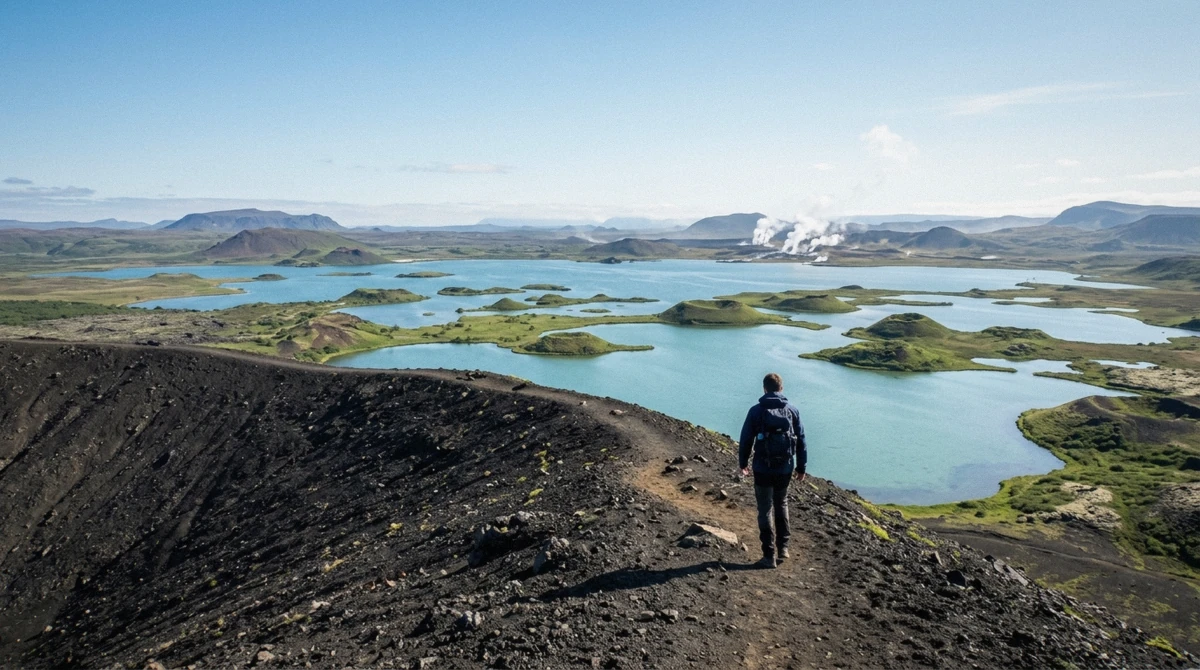
Is Lake Mývatn worth visiting? Yes, and the reason is density. Inside a basin of 37 km² you get grassy pseudo-craters, a collapsed lava city, a tephra crater 1,000 metres across that you can walk the rim of, ground that boils at 200°C a short way down and geothermal water to finish in. Nowhere else in Iceland puts that range inside a 20 minute drive. The case against it is real too: two hours of driving from Akureyri, insects in July, and a landscape that reads as brown and bare on a grey day. Here is the version I give people who ask me in the bus. If you have already decided, what the Lake Mývatn tours actually cover is on the homepage.
Quick answer
Lake Mývatn is worth a full day if you are in north Iceland and want volcanic ground rather than another waterfall. Five headline sights sit within 20 km of each other and none of them charges an entry fee. The trip from Akureyri takes about 75 minutes each way, guided departures run 6 to 7 hours and cost $132 to $211, and driving yourself costs fuel plus a rental day. Skip it only if your time in the north is under six hours.
Key takeaways
- The pull is variety: pseudo-craters, a lava labyrinth, a 1,000 m explosion crater, boiling mud and a geothermal lagoon in one basin
- Nothing at the sights costs money. Goðafoss, Dimmuborgir, Hverfjall, Grjótagjá and Hverir are all free to enter and park at
- Budget six hours from Akureyri, of which about 150 minutes is driving. Under that and the day stops making sense
- June to August brings midges in clouds. A head net costs a few hundred krónur and removes the single biggest complaint
- The cheapest guided day runs $132 per person, less than a rental car once you count fuel for the 200 km round trip
- Not worth it for: a four-hour port call, anyone who dislikes uneven ground, or a traveller who has already seen Iceland's geothermal areas in the south
What Actually Makes It Worth the Drive
Five landscapes, twenty kilometres
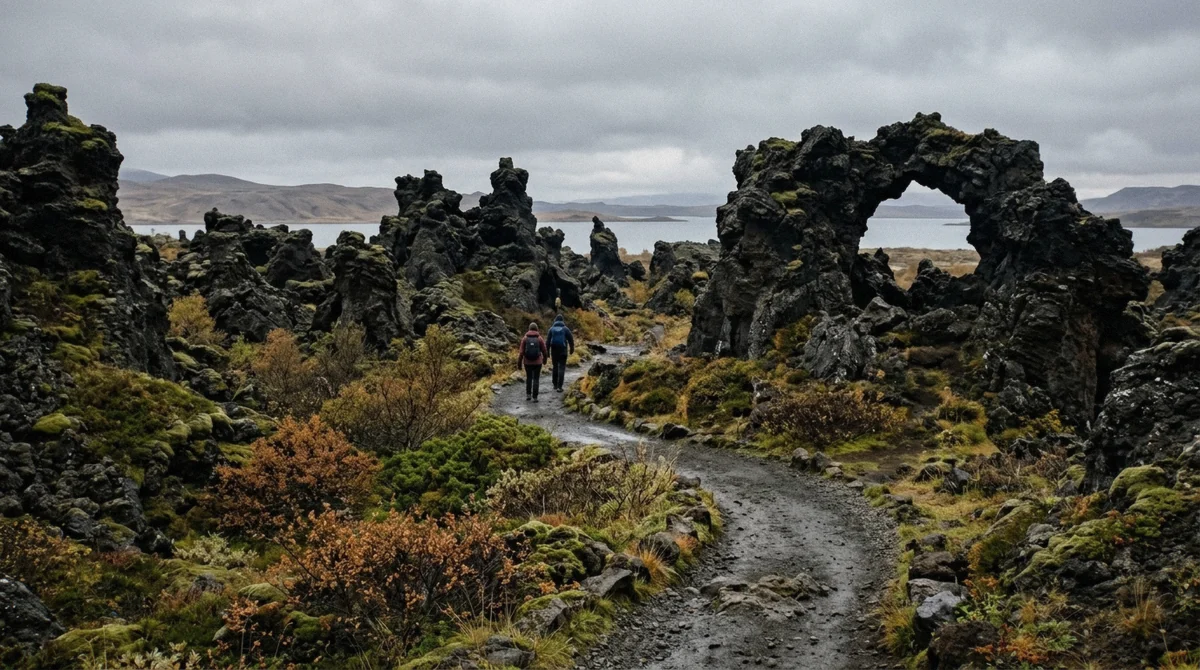
Iceland asks you to drive a long way between good things. Mývatn is the exception. Start at Skútustaðagígar on the south shore, where lava ran over wet ground about 2,300 years ago and blew rings of ash into grassy craters that were never volcanoes. Ten minutes later you are inside Dimmuborgir, a lava lake that drained and left pillars and arches standing. Behind it Hverfjall rises, a tephra ring 1,000 metres across and 140 metres deep, thrown up in a single eruption around 2,800 years ago, with a path to the rim that takes 20 minutes.
A short drive north is Grjótagjá, a fissure with clear blue water at the bottom, and over the pass sits Hverir, where the ground gives up on plants entirely and turns to orange clay, mud pools and vents. Finish at the geothermal lagoon on the ridge above the lake. That sequence is the argument.
The wildlife nobody mentions in the brochure
Fifteen duck species breed here, the densest concentration in Europe. Around 6,000 pairs of tufted duck and 1,500 pairs of greater scaup nest on the shore, alongside Barrow's goldeneye, which lives here year round and nowhere else in Europe. The lake joined the Ramsar list of internationally important wetlands on 2 December 1977 and sits inside a conservation area of 4,400 km².
On the bed grow marimo, spheres of green algae that were declared gone in 2013 and have since started to return. You will not see one without a boat. The ducks you will see from the car park at Skútustaðagígar, and that is where a pair of binoculars earns its space in the bag.
It is free
This surprises people arriving from countries where a national park means a gate and a ticket. Nothing here charges. Goðafoss, Dimmuborgir, Hverfjall, Grjótagjá, Hverir and Skútustaðagígar all cost nothing to enter and nothing to park at.
The only thing you pay for at the lake is the geothermal lagoon, from 7,900 ISK, and food. What a guided trip buys you is the driving and the commentary, not access.
The Short Answer
Worth it if
You have a full day in north Iceland and you want ground that does something rather than another view of it.
- You have six hours or more and no fixed return to a ship
- Volcanic landscape interests you more than one more waterfall
- You are driving the ring road and can give the north two nights
Skip it if
The honest cases where the drive does not pay for itself.
- Your port call is six hours or less, since the driving alone eats half of it
- You need level, paved paths, because Hverfjall and Hverir provide neither
- You came straight from Geysir and Hveragerði and wanted something that is not geothermal
Why Some Visitors Leave Disappointed
Four things that spoil the day, and what to do about each
The complaints are consistent enough to list, and every one of them is avoidable.
- Flat grey light. On an overcast day the basin reads brown and bare, and the photographs come back dull. Check the forecast the night before and swap days if you can, since the sights are open all year and your itinerary usually is not
- Midges. Between June and August they swarm the shore, and people who arrive without a head net remember the insects instead of the craters. A net costs a few hundred krónur in Akureyri
- Too little time. Four stops in five hours turns Dimmuborgir into a photo stop. Take a six-hour departure or drive yourself and give the lava field a full hour
- Expecting a lake day. You cannot swim here, boat trips are restricted and the water is 2.5 m deep on average. The lake is the reason the landscape exists, not the attraction
The one that is nobody's fault
Wind. It closes the Hverfjall rim path, makes Hverir unpleasant and occasionally shuts Route 1 east of the lake. Operators cancel for it rather than run a bad day, and free cancellation 24 hours out is what makes that survivable.
Book the first suitable date of your stay rather than the last.
Mývatn or the Golden Circle
Against the route everyone does first
Most people asking whether this is worth it have already booked the Golden Circle out of Reykjavík. The two are not substitutes.
| Lake Mývatn | The Golden Circle | |
|---|---|---|
| From | Akureyri, 100 km, 75 minutes | Reykjavík, 60 to 100 km per stop |
| Headline sights | Craters, lava field, boiling ground, lagoon | Geyser, rift valley, one large waterfall |
| Entry fees | None at any sight | None, parking charged at two stops |
| Guided day | $132 to $211, 6 to 7 hours | Similar price, 8 hours |
| Crowds | Busy 11:00 to 15:00, empty otherwise | Busy from opening to closing |
| Geothermal water | Lagoon on the ridge, from 7,900 ISK | Secret Lagoon or the Reykjanes complex |
| Best for | A second Iceland trip, or anyone flying north | A first trip with three days in the country |
Doing both
They sit 480 km apart, which is a full driving day or a 45 minute flight. Anyone with a week does both without trying. Anyone with three days should pick the one their arrival airport points at.
When It Is Worth It Most
The windows that change the answer
Late August into the first half of September is when this day is at its best: the midges have finished, the light still runs 13 hours, every road is open and the coaches have thinned. June and July give more daylight and every operator running, with insects and company as the price.
From November to March the answer narrows rather than flips. The core ring stays open, the steam at Hverir stands twice as tall in cold air and the aurora season runs, but daylight falls to between three and five hours and the Krafla road is shut. Month by month sets out what each one gives you.
How to Book Without Overpaying
What actually moves the price
Not the season. The operators here charge the same in February as in July, which is unusual in Iceland. What moves your cost is the format: a coach seat with a packed lunch runs $181.05, a minibus with a cave stop $134.37, and the cheapest harbour departure $132 with transport and guiding only.
Book two to four weeks out for July dates and a few days out for anything else. Everything on this page takes no payment at booking and cancels free up to 24 hours ahead, so there is no reason to wait for a better price that will not come. Compare the Lake Mývatn day trips from Akureyri on price per hour outside the bus rather than on headline price.
Where people overspend
Two places. Buying the cruise line's version of the same road, which typically starts around $200 against $132 to $184 booked directly. And paying for the tour that ends at the lagoon without checking that the lagoon ticket, from 7,900 ISK, is extra on top.
The Honest Ledger
What we genuinely like
- Five distinct volcanic landscapes inside a 20 km radius
- No entry fees anywhere, including the biggest sights
- Guided departures from $132, cheaper than most Iceland day tours
- Europe's densest breeding duck population, visible from the shore
- Geothermal water at the end of it, from 7,900 ISK
- Far fewer people than the Golden Circle at the same hour
The honest downsides
- Two and a half hours of driving from Akureyri and back
- Midges swarm from June to August and can be relentless on still days
- Ground is uneven at every stop, with loose gravel at Hverfjall and Hverir
- The Krafla road and the ice cave are closed for much of the year
- On a flat grey day the colour drains out of the whole basin
- Sulphur smell at Hverir clings to clothing
Who it's NOT for: Anyone with under six hours in north Iceland, travellers who need level paths throughout, or people who have just come from the geothermal fields at Geysir and Hveragerði in the south and want something different.
How It Compares With Iceland's Other Day Trips
Against what you might do instead
Most people asking this question are choosing between Mývatn and something else in the north.
| Day out | From Akureyri | Cost | What you get |
|---|---|---|---|
| Lake Mývatn | 6 to 7 hours | $132 to $211 guided | Craters, lava, boiling ground, lagoon |
| Húsavík whale watching | About 5 hours | Similar per person | Boat time, one species focus, weather dependent |
| Forest Lagoon and Akureyri | Half a day | From 7,490 ISK entry | Water and a town, no driving |
| Dettifoss and Ásbyrgi | Full day | Fuel or a longer tour | One enormous waterfall, one canyon |
| The full Diamond Circle | 10 hours plus | More | All of the above, none of it slowly |
The Diamond Circle trap
The northern route strings together Goðafoss, Mývatn, Dettifoss, Ásbyrgi and Húsavík, and it is sold as one day. It fits in a day the way five cities fit in a week. Dettifoss is 50 km northeast of the lake and Húsavík 50 km north, so attempting the whole loop leaves you 20 minutes at each stop and a lot of windscreen.
The six-hour tours here take the western half deliberately. If you have two days, do Mývatn on one and the north coast on the other. If you have one, do this half.
What the day costs, three ways
The sights are free, so the whole question is how you get there and what you add on. Figures are per person for two people travelling together, which is where self-driving starts to compete.
| Way in | Per person | What is included | What is extra |
|---|---|---|---|
| Cheapest guided day | $132 | Transport and guide, 6 hours | Food, lagoon entry |
| Most reviewed guided day | $181.05 | Transport, guide, packed lunch | Lagoon entry |
| Guided day ending in the water | $210.66 | 7 hours, five stops, guide | Lagoon entry from 7,900 ISK |
| Rental car, two sharing | Rental day plus fuel | Your own pace, any stop | Everything else, and the driving |
| Public bus 56 | Bus fare only | A seat to Reykjahlíð | No way to reach the sights |
Worth It For You?
If You have a full day in north Iceland
Yes. Take the classic ring and add the lagoon if you have seven hours
If Your ship is in port for six hours or less
No. Stay in Akureyri, take Forest Lagoon or a whale boat
If You are driving the ring road
Yes, and stay two nights at Reykjahlíð rather than passing through
If You visit in July and hate insects
Yes, with a head net. Without one you will remember the wrong thing
If You need level, paved paths
Partly. Goðafoss and the lagoon work; Hverfjall and Hverir do not
If You came for the northern lights
Yes, between September and April, and stay the night rather than day-tripping
What People Get Wrong Before They Come
That it is a lake day
The water is 37 km² of shallow, cold, protected lake with an average depth of 2.5 m. You cannot swim in it, boating is restricted and nobody comes here to look at the surface for long. The lake is the reason the landscape exists, not the attraction itself.
The attractions are what the lava did on the way past.
That the midges are a myth
Mý-vatn means midge lake. Two species hatch from the shallows between June and August, one that bites and one that does not, and numbers swing hard from year to year. A traveller in July 2026 was told by her driver that the swarm that summer was a third of the previous one, and she still advised buying a net.
They clear by early September. The full packing list has the rest.
That everything is open all year
The road up to Krafla and the Víti crater closes under snow into late spring. Lofthellir, the ice cave 40 km east, runs guided trips from May to October only. The core ring stays open all year, which is what the winter departures run.
Anyone planning around the caldera should read when to come first.
Our recommendation
🎯 One full day, guided, and buy the net
The version of this day that fails is the rushed one: four stops in five hours with a ferry or a flight at the end of it. The version that works is six hours with an hour at Dimmuborgir, a climb up Hverfjall if the wind allows, and the lagoon afterwards if you have the time.
If you are staying in Akureyri and have no car, the guided route is also the cheaper one once you price a rental day. The comparison of every Lake Mývatn day trip sits on the homepage, and the self-drive maths is there if you would rather do it alone.
Questions People Ask First
How much time should you spend at Lake Mývatn?
One full day covers the classic ring: Goðafoss, Skútustaðagígar, Dimmuborgir, Hverfjall and Hverir. That is what the six-hour guided departures do. A second day buys Krafla, the Víti crater, Lofthellir and a run north to Dettifoss or the whales at Húsavík. Two nights at Reykjahlíð is the comfortable version.
What is the number one thing to see at Mývatn?
Hverir, if you want the one that looks like nowhere else: orange clay, mud pools and vents with ground temperatures over 200°C a short way down. Dimmuborgir wins on atmosphere and Hverfjall on the view. The ranked list of what to do goes through all eight.
Is Mývatn better than the Golden Circle?
Different, and emptier. The Golden Circle gives you a geyser, a canyon and one enormous waterfall within reach of Reykjavík, and it is busy at every hour. Mývatn trades the crowds for a longer drive and a wider spread of volcanic ground. If you have already seen Geysir, the mud pools here will still feel new.
Can you visit Lake Mývatn without a car?
Yes, on a guided departure from Akureyri, which is what most visitors without wheels do. The public bus stops at Reykjahlíð but leaves you 30 km from most of the sights with no local transport. Getting there covers all the options and their timings.
Is it worth visiting in winter?
Yes, with a shorter list. The core ring stays open and the crowds vanish, but daylight runs about three hours in mid December and the Krafla road is shut. The trade is aurora season and steam that stands twice as tall in cold air.
Is Lake Mývatn expensive?
The sights cost nothing. A guided day runs $132 to $211 per person, the geothermal lagoon starts at 7,900 ISK, and a night in Reykjahlíð runs from about $110 to $160. Compared with the rest of Iceland it is one of the cheaper full days you can have, which the where to stay guide breaks down.