Best Time to Visit Lake Mývatn, Month by Month

The best time to visit Lake Mývatn is late August and early September, which is the answer most guides here would give you and few write down. The midges have gone, the roads are all still open, the aurora season has started and the coaches have thinned. June and July give you more daylight and every departure running, at the cost of insects and company. From November to March the basin is beautiful, quiet and short on light: three hours of it in mid December. Below is what each month actually gives you, with the numbers behind it. The Lake Mývatn departures by month are listed on the homepage.
Quick answer
The best time to visit Lake Mývatn is late August to mid September: the midges are finished, every road is still open, aurora season has begun and the summer crowds have gone. June and July offer the longest days and the fullest tour schedule but the heaviest insects. November to March gives you empty sights and aurora, with only three to five hours of daylight and the Krafla road closed.
Key takeaways
- Midge season runs June to August, peaks on warm still days and clears by early September
- Daylight swings from 3.2 hours in mid December to 22.8 in mid June at this latitude
- July is the warmest month at an average high of 14.2°C; January averages minus 1.8°C by day
- Aurora season runs September to April, and the basin has almost no light pollution
- The Krafla road and the Víti crater stay under snow into late spring; Lofthellir cave runs guided May to October
- Guided departures run all year, thinning from November, and cost the same $132 to $211 in any month
The Numbers Behind Each Month
Daylight, temperature and what it means
Daylight is calculated for 65.6 degrees north, the latitude of the lake, on the fifteenth of each month. Temperatures are the long-run averages recorded at Reykjahlíð on the northeast shore, where the annual mean is 1.4°C and precipitation totals 435 mm, which is dry by Icelandic standards.
| Month | Daylight | Avg high | Avg low | What it means |
|---|---|---|---|---|
| January | 4.6 h | −1.8°C | −8.4°C | Aurora season at full strength, three usable hours of light |
| February | 8.1 h | −0.9°C | −7.6°C | Light returns fast, still deep winter on the ground |
| March | 11.4 h | −0.3°C | −7.2°C | Best winter month: light and aurora both |
| April | 15.1 h | 3.0°C | −3.9°C | Thaw, mud, Krafla road still shut |
| May | 18.9 h | 7.6°C | 0.6°C | Birds arrive, Lofthellir opens, no midges yet |
| June | 22.8 h | 12.3°C | 4.5°C | Midnight sun, first midge swarms |
| July | 20.7 h | 14.2°C | 6.4°C | Warmest and busiest, midges at peak |
| August | 16.7 h | 12.9°C | 5.6°C | Midges fade late in the month, everything open |
| September | 13.0 h | 8.1°C | 1.9°C | The sweet spot: no insects, aurora starts |
| October | 9.4 h | 3.6°C | −1.6°C | Quiet, colour on the heath, first snow |
| November | 5.8 h | 0.0°C | −6.1°C | Departures thin out, Krafla closes |
| December | 3.2 h | −1.4°C | −8.0°C | Shortest days, Dimmuborgir at its most festive |
When to book, and how far ahead
Departure numbers move with the season, and so does how early a date closes. July fills first, February barely fills at all, and the shoulder weeks sit in between. Prices do not follow the same curve: the operators here charge the same $132 to $211 in February as in July, which is unusual in Iceland and worth using.
| Window | Departures running | How far ahead to book | Beds at Reykjahlíð |
|---|---|---|---|
| June to August | All nine, daily | Two to four weeks in July | Highest, book early |
| May and September | Most, near daily | A week is usually enough | Mid range, easy |
| October and April | Fewer, some days blank | A few days ahead | Low |
| November to March | Winter operators only | A few days, weather permitting | Lowest of the year |
Seasons at a Glance
Four seasons, four different days out
Daylight is calculated for 65.6 degrees north; temperatures are the long-run averages at Reykjahlíð on the northeast shore.
| Season | Weather | Midges and roads | Crowds | Verdict |
|---|---|---|---|---|
| Summer, June to August | 12 to 14°C by day, 17 to 23 h of light | Midges at peak, every road open | Heaviest, coaches 11:00 to 15:00 | Best access, worst insects |
| Autumn, September and October | 4 to 8°C, 9 to 13 h of light | No midges, Krafla closes in October | Thin after the first week | Best overall |
| Winter, November to March | −2 to 0°C, 3 to 8 h of light | No midges, Krafla and Lofthellir shut | Almost none | Aurora, short days |
| Spring, April and May | 3 to 8°C, 15 to 19 h of light | No midges yet, thaw and mud | Light until late May | Quiet, half the caldera still shut |
Season by Season
Summer, June to August
Everything runs. Every operator, every road, the ice cave, the boat on the Laxá and the caldera at Krafla once the snow clears. Light stops being a constraint: on 15 June the sun is above the horizon for nearly 23 hours, which means you can walk Dimmuborgir at 22:00 with the place to yourself while the coaches sleep.
The cost is insects and company. Midges hatch in clouds from the shallows, worst on warm still days near the shore. The car parks at Goðafoss and Dimmuborgir fill between 11:00 and 15:00 as the day trips arrive. July is the warmest month at 14.2°C by day and the single busiest.
What to do about it: start early or go late, and buy a head net before you leave Akureyri.
Shoulder, May and September
May gives you the birds arriving, snow still on the high ground, 18.9 hours of light and no midges at all. Lofthellir opens for guided trips. The Krafla road usually stays shut into the second half of the month.
September is the better half of the pair. The insects finish in the last days of August, the light still runs 13 hours, the heath turns rust and gold, and the aurora season opens with skies dark enough by 22:00. Every road remains open through the month in a normal year. If someone asks me for one week to book, it is the first week of September.
Winter, October to April
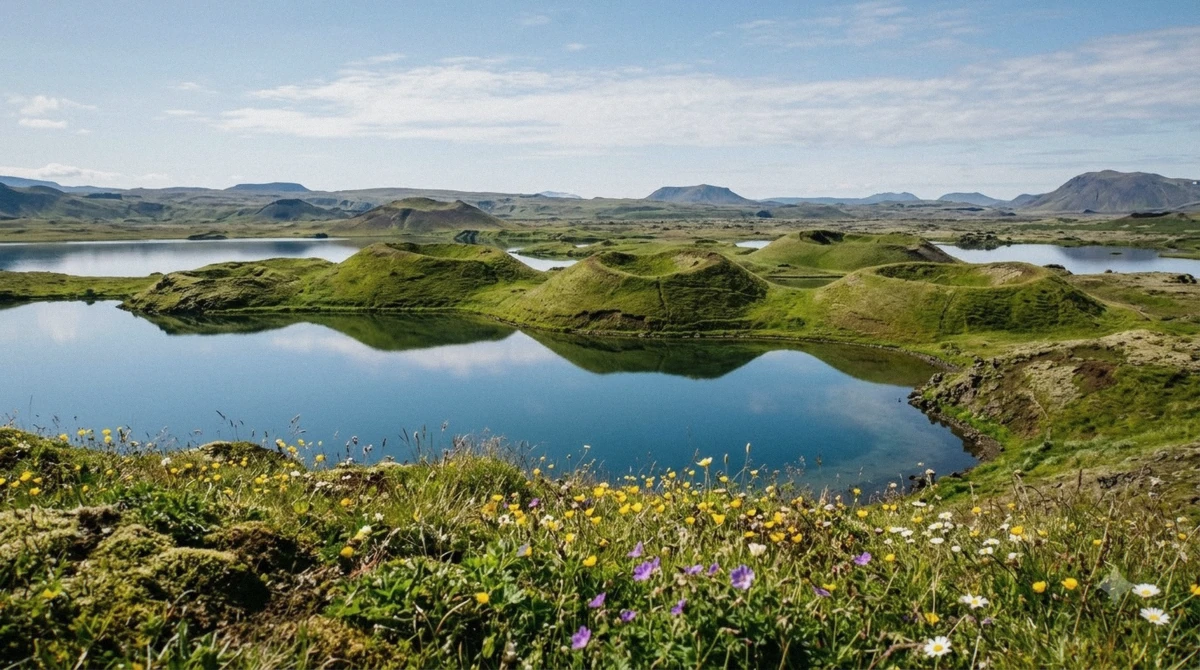
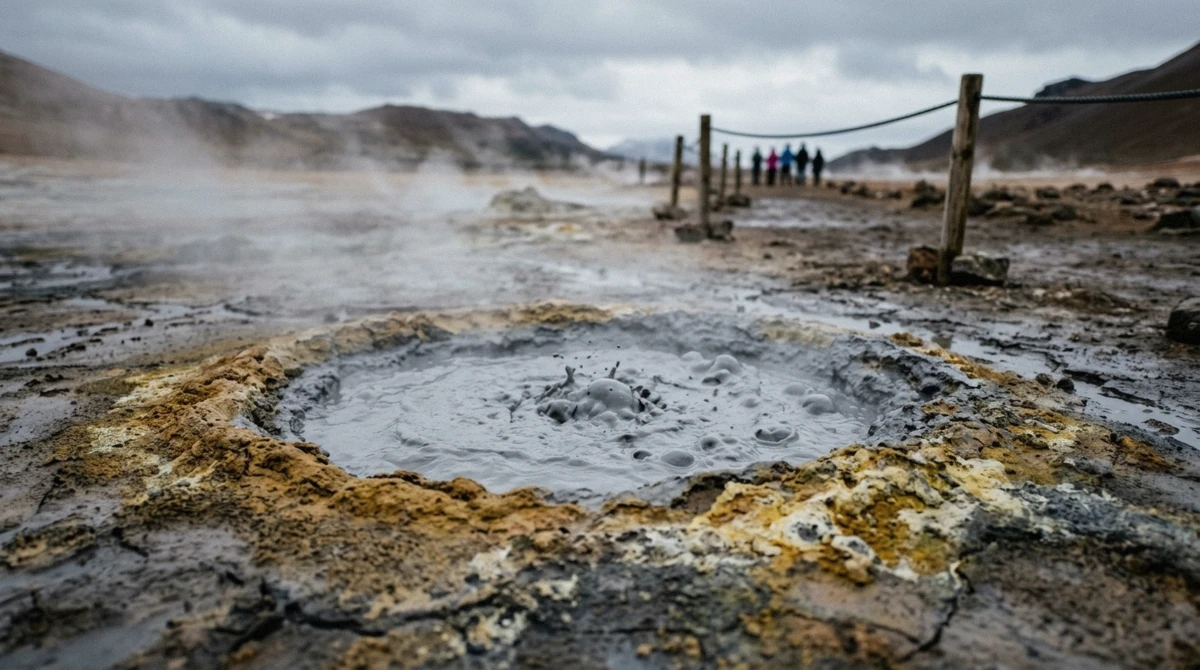
The basin empties. Snow flattens the pseudo-craters, the steam at Hverir stands twice as tall in cold air, and Dimmuborgir turns into the place Icelandic children associate with the thirteen Yule Lads in December.
What you lose: the Krafla road and the Víti crater, closed under snow into late spring; Lofthellir, closed until May; the unpaved tracks, unplowed. Daylight falls to 3.2 hours in mid December, which is why a six-hour tour in that month is mostly a drive with three golden stops.
What you gain: aurora over a basin with no town lights, a geothermal lagoon open to 23:00, and the cheapest beds of the year. The winter departures cover the details.
Best Time of Day
Early, or after eight in the evening
The coaches reach this end of the lake between 11:00 and 15:00, and every complaint about crowds at Dimmuborgir comes from that window. Anything outside it is a different visit.
In June and July the light holds past 22:00, so an evening circuit gives you empty car parks and low sun on the pseudo-craters. From September the same logic runs in the morning instead: be at Dimmuborgir by 09:30 and you will have walked the loop before the first bus arrives. The lagoon inverts it, since it stays open to 23:00 and empties after 20:00 in any month.
Crowds and Prices Through the Year
What fills and what does not
Two things drive crowding here and neither is the calendar alone. The first is cruise calls at Akureyri between May and September, which put four buses on the same road on the same morning. The second is the ring road itself, which delivers a season of drivers through a basin with a few hundred beds in eight weeks.
Prices behave differently. The nine departures charge the same $132 to $211 in February as in July, so the seasonal premium lands on accommodation rather than on touring. A room that runs about $108 to $161 in September costs well above that in mid July and falls below it from November.
What If the Weather Turns
Rain is fine, wind is not
Rain does not cancel anything here. Wind does, and so does the drifting snow that follows it, because both close the pass east of the lake rather than merely making the day unpleasant.
Operators cancel rather than run a bad trip, and every departure on this site refunds automatically and takes no payment at booking. The practical move is to book the first suitable date of your stay so a cancellation still leaves you a second attempt, and to check road.is on the morning rather than the night before. If the forecast is ugly and you are driving yourself, the winter departures run the same road with someone who has done it in the dark.
Pick Your Month
If You want the northern lights
September to March. September and March pair aurora with usable daylight
If You cannot stand insects
September to May. The midges are gone entirely outside June to August
If You want every road and cave open
Late June to early September, when Krafla and Lofthellir are both reachable
If You are coming by cruise ship
May to September, which is when Akureyri takes ships at all
If You want the lowest prices on beds
November to March, when Reykjahlíð rooms fall well below the summer rate
If You want one week and no compromises
The first week of September
The Midge Question, Answered Properly
When, how bad and what to do
The lake is named after them: mý is midge, vatn is lake. Two species hatch from the shallow water, one biting and one not. They appear in June, peak through July and August, and are gone by the first days of September.
Numbers swing hard between years, driven by how the larvae fared in the mud over winter. A visitor in July 2026 was told by her driver that year's swarm ran at a third of the previous summer's, and she still recommended a net to anyone reading. Two more reviewers on the same route wrote the word net in the same sentence as the word bugs.
- Worst: warm, still, sunny afternoons on the shore at Skútustaðagígar
- Better: windy days, anywhere above the water, and the geothermal ground at Hverir
- A head net costs a few hundred krónur in any Akureyri shop and guides carry spares
- They do not bite in the way mosquitoes do; they swarm the face, which is worse for morale and better for skin
- Eating outside near the shore in July is a losing proposition. Eat on the bus
What Is Open When
Access by season
The core ring is open all year. The edges are not.
| Sight | Summer | Winter | Note |
|---|---|---|---|
| Goðafoss | Open | Open | Icy steps on the bank from November |
| Skútustaðagígar | Open | Open | Snow hides the crater shapes |
| Dimmuborgir | Open | Open | Packed trails, traction spikes help |
| Hverfjall | Open | Usually open | Loose gravel becomes ice on the rim path |
| Grjótagjá | Open | Usually open | Depends on the access track |
| Hverir | Open | Open | Best in cold air |
| Krafla and Víti | Open once snow clears | Closed | Road under snow into late spring |
| Lofthellir cave | Guided May to October | Closed | Track needs a modified vehicle |
| Earth Lagoon | Open to 23:00 | Open to 23:00 | Reopened 9 July 2026 after a rebuild |
Our recommendation
🎯 Come in the first half of September
You get 13 hours of daylight, no insects, every road still open, autumn colour on the heath and a real chance of aurora after 22:00. Beds cost less than in July and the car parks are half empty by then.
If your dates are fixed in summer, book a departure that starts early rather than at 10:00, carry a net, and put the geothermal lagoon at the end of the day. If they are fixed in winter, accept a shorter list and pick a clear night. Either way, the full comparison of Lake Mývatn tours shows which operators run in your month.
Timing Questions
What is the best month to visit Lake Mývatn?
September, and specifically the first half of it. The midges have finished, daylight still runs about 13 hours, every road remains open, the heath has turned colour and the aurora season has started. July is the alternative if you want maximum daylight and do not mind insects or company.
When are the midges worst at Mývatn?
June through August, with the heaviest swarms on warm, still afternoons near the shore. They clear by the first days of September. Numbers vary widely between summers. A head net for a few hundred krónur makes the difference between a good day and a memorable one for the wrong reason.
Can you see the northern lights at Lake Mývatn?
Between September and April, when the sky gets dark enough. The basin sits far from any town, so light pollution is not the limiting factor; cloud is. The geothermal lagoon stays open until 23:00, which is the comfortable way to wait for a display.
How many hours of daylight are there in winter?
About 3.2 hours in mid December, 4.6 in mid January, 8.1 in mid February and 11.4 by mid March. The sun stays low all day, so what light there is comes in golden and stays that way.
Is Lake Mývatn open in winter?
The core sights are: Goðafoss, Skútustaðagígar, Dimmuborgir, Hverfjall, Grjótagjá and Hverir. The Krafla road and the Víti crater close under snow into late spring, and the Lofthellir ice cave runs guided trips from May to October only. Route 1 and road 848 are plowed year round.
How cold does it get?
January averages minus 1.8°C by day and minus 8.4°C at night at Reykjahlíð, with an annual mean of 1.4°C. The cold is dry rather than raw. Wind is what decides how the day feels, which is why the packing list leads with a shell rather than a thick coat.
Is one day enough?
For the classic ring, yes, and that is what the six-hour departures cover. Add a second day for Krafla, Lofthellir, Dettifoss or Húsavík. The case for coming at all is set out in is it worth visiting.